Illinois Universal Mental Health Screening
The Complete District Guide

This guide was created by Maro to help Illinois district leaders navigate SB1560 implementation. It reflects our interpretation of the mandate and the ISBE guidance available at time of publication. Because implementation guidance continues to evolve, we recommend verifying current requirements directly with your regional ISBE office. This document is not affiliated with or endorsed by the Illinois State Board of Education.
Introduction
Illinois is the first state to require annual mental health screenings for students in grades 3-12. Under SB1560, every district must be in compliance by the 2027-28 school year. But what does this really mean for your schools, and how should you start preparing now?
This guide is for district leaders, student support coordinators, school counselors and social workers navigating SB1560 implementation.
At Maro, we’ve spent years working with student support teams in 21 districts across Illinois to implement universal mental health screening. The schools that have the most success start earlier than they think they need to and use this as an opportunity to create capacity for their staff.
This guide is designed to help you do that.
What does the SB1560 law say?
SB1560 is the new law that requires Illinois school districts to implement universal mental health screening for students in grades 3 through 12. Every district must be in compliance by the 2027-28 school year.
This law was created with input from communities across the state, including feedback on schools’ perception of universal screening and implementation and a statewide district readiness assessment.
Here’s a breakdown of the law & available guidance:
Universal screening: Screening must be made available to every student in grades 3–12.
Qualifying screening tool: Districts must use a qualifying mental health screening tool; SEL screeners will not count.
Trained personnel: Staff who administer and review screening results must receive appropriate training.
Family notification: Families must be informed about the screening program and how results will be used.
Follow-up protocols: Districts must have a plan in place for responding to students who screen positive.
Note: Screening does not require a clinical diagnosis and is not a substitute for a full evaluation.
Choosing the right screening tool
The four most widely used mental health screeners in Illinois K-12 settings are the PHQ-9, GAD-7, PSC-35 and K-CAT.
PHQ-9 (Patient Health Questionnaire): Screens for depression. Consists of nine questions.
GAD-7 (Generalized Anxiety Disorder): Screens for anxiety. Consists of seven questions.
PSC (Pediatric Symptom Checker): Screens for attention, internalizing (anxiety, depression), and externalizing (behavioral) concerns. Consists of 35 questions.
K-CAT (Knowledge-based Child Adaptive Test): Screens for any combination of anxiety, depression, suicidality, and ADHD. Adjusts its questions in real time based on a student's responses.
These tools are widely validated in child or adolescent populations, short enough to administer in a single class period, available in multiple languages and interpretable by school counselors without clinical licensure (with appropriate training). Other tools may be used to further assess students who are flagged.
Key Questions to Ask When Evaluating a Screener
Is it validated for the age range you’re screening?
Is it available in the languages your students speak?
How long does it take to administer?
Maro’s platform has a library of evidence-based mental health screeners built in, including the PHQ-9, GAD-7, PSC and K-CAT. These surveys take 10 minutes or less to administer. Because Maro is screener-agnostic, our implementation tools (consents, family communications, referrals and more) are compatible with a variety of mental health screeners.
Building your screening workflow
Roles and Responsibilities
Most districts find it helpful to assign clear roles before they go live with screening. A framework that works well:
Classroom or homeroom teachers administer the screener during a scheduled window.
A counselor, social worker, or designated support staff member conducts follow-up with students who screen positive.
A district-level coordinator reviews aggregate data to identify patterns across buildings.
Cadence: How Often to Screen
SB1560 envisions screening as an ongoing practice. Most of our partner schools elect to screen twice per year (once in fall and once in spring) to detect patterns and catch students whose mental health changes over time.
Tips for Effective Screening
Screenings should be conducted early in the week and well in advance of holidays so that staff have ample time to follow up before students go home for the weekend or head out on break.
Most schools elect to screen 1-4 grades at a time so that staff can manage follow up and documentation before screening more students.
Minimal Disruption to Class Time
How do schools fit this in without disrupting instruction?
Schedule screening during advisory periods, homeroom, or existing social-emotional learning blocks rather than carving out new time.
Build screening into a week that’s already low-stakes instructionally (e.g. not before state assessments or during testing windows).
Coordinate across classrooms/buildings so that you screen a manageable number of students per day.
A Realistic Rollout Timeline
Spring 2026: Consider a soft launch with one building or one grade band.
Summer/Fall 2026: Refine based on what you learned, and prepare to scale up for district wide rollout. Train relevant staff.
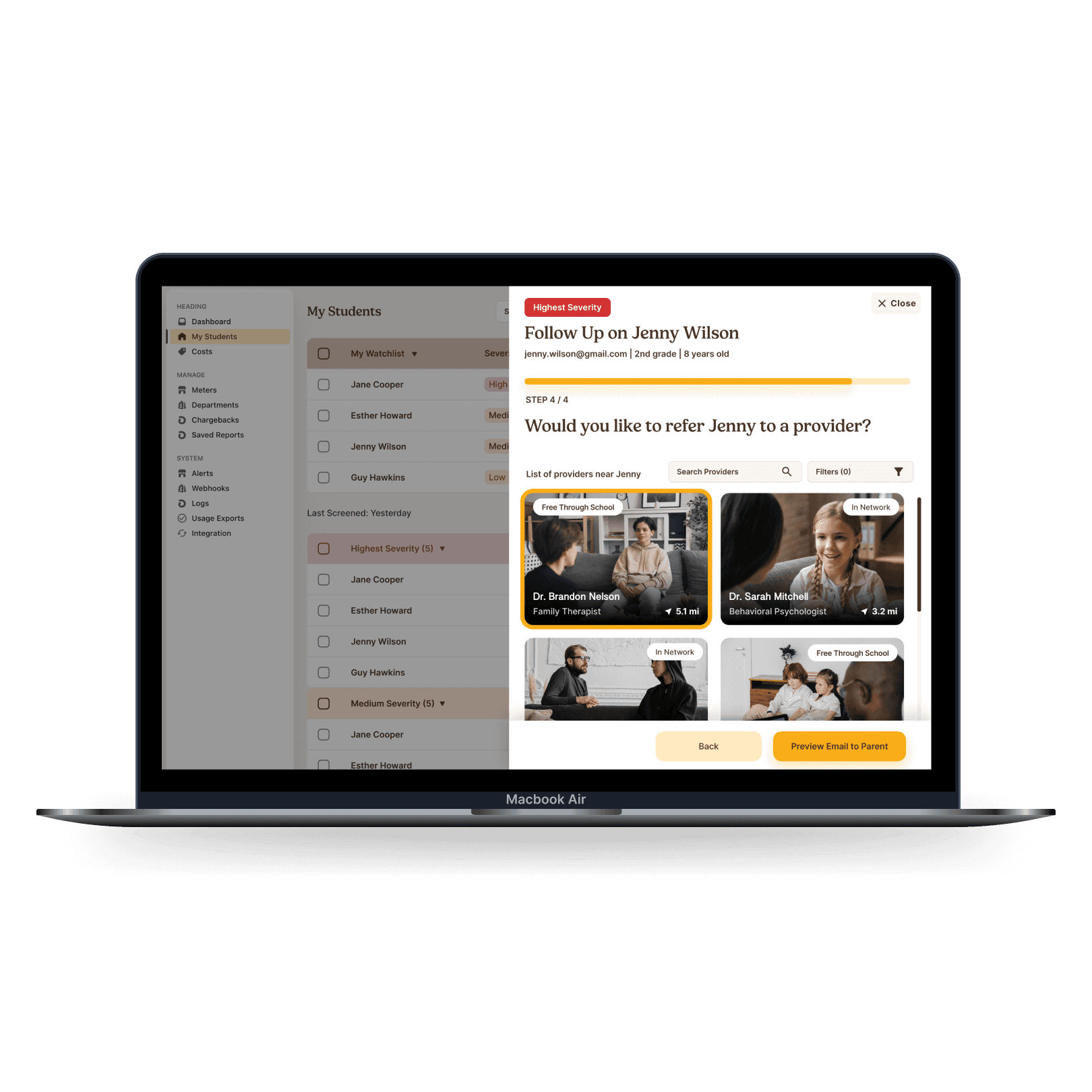
With Maro, an implementation specialist can help you develop a custom screening plan and sync your student roster in as little as 1-2 meetings.
"The platform was user-friendly, so we were able to monitor and log follow ups and brief interventions easily for each individual student based on their needs. The platform even categorizes students based on their risk level, so it is clear which students fall into Tier I-III needs."
ECHO Alternative School
Regional Office of Education 21 | Illinois
Triage and follow-through
Universal screening is a very effective tool when it’s paired with intervention for at-risk students.
What Happens After a Student Screens Positive
A positive screen is not a diagnosis, but it is a signal that a student may need additional support and that someone should find out more. The appropriate response depends on the severity of the student’s responses and what your district’s support infrastructure looks like. A follow-up plan should be determined and documented ahead of screening.
A Tiered Response Framework
Here is a general framework used by many of Maro’s partners in Illinois:
Tier 1 (mild responses): No follow up needed.
Tier 2 (moderate responses): Check in with student within 24-28 hours. Assess whether further resources are needed.
Tier 3 (severe responses): Check in with student same day. Check in with parents as needed. Crisis protocol activated if warranted.
Protecting Staff Bandwidth
One of the most common concerns we hear from student support teams is that universal screening will mean more work on already-stretched counselors. That concern is legitimate.
When done well, universal screening should save counselors’ time. Early detection means fewer crisis interventions down the road. Catching a student at moderate severity is far less resource-intensive than responding to a crisis.
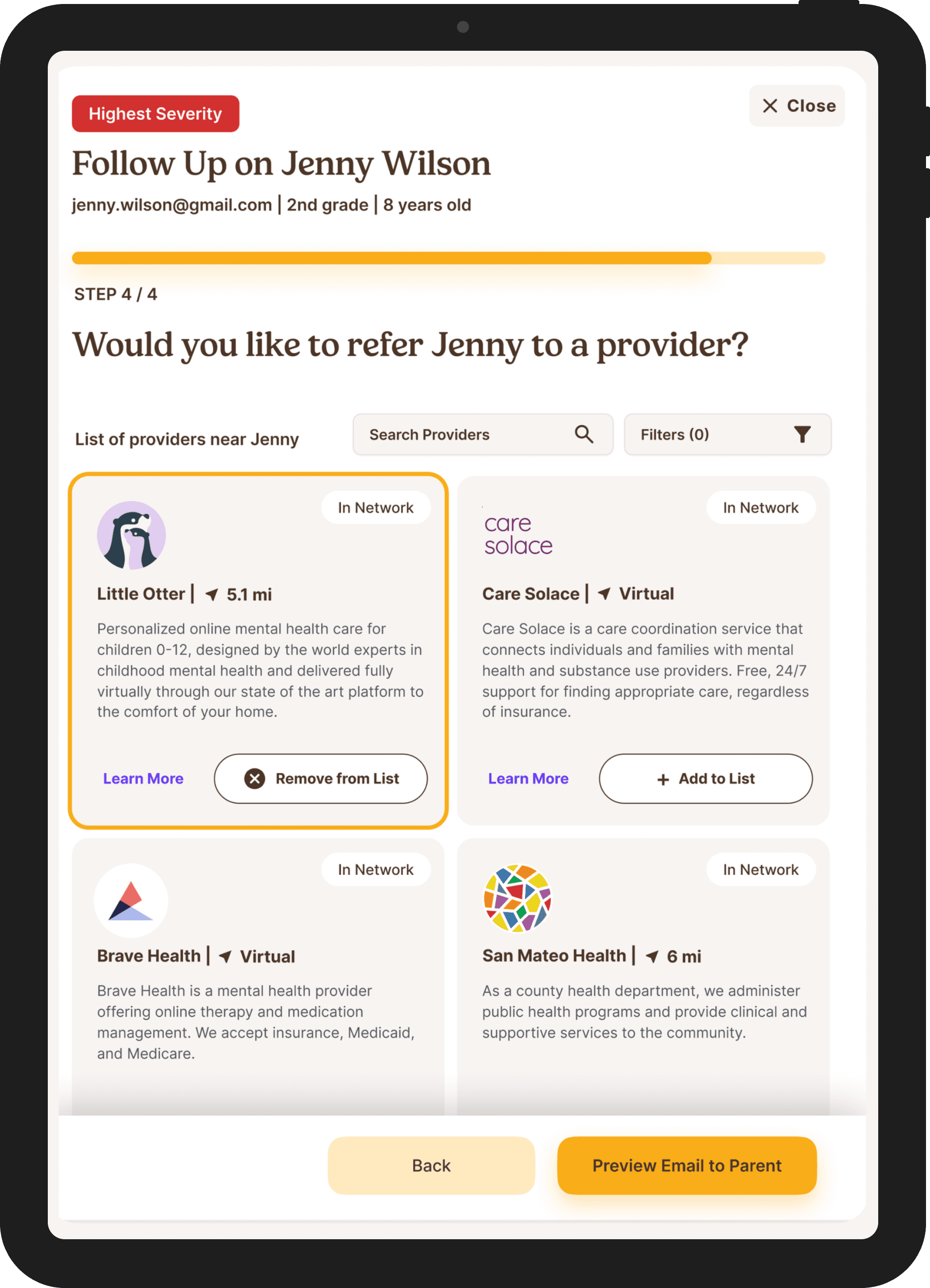
Maro streamlines the administrative work that typically follows screening: documentation, provider referrals, and follow-up tracking are all built in to the platform.
Family communication
One of the biggest concerns districts raise around student mental health screening is how to communicate clearly with families and manage consent smoothly. Schools we work with have found that having simple, transparent parent communication tools makes the process far easier for staff and builds trust with families.
When parents understand why screening is happening and what happens with results, they're far less likely to opt out or push back. Partnerships with families can create open dialogue around mental health, promote honest conversations, and ensure programs are community-informed — all of which promotes buy-in.
Here are some general tips for coordinating with families:
Communicate early and clearly —Proactive communication about the purpose, process, and what happens next goes a long way.
Emphasize it's not a diagnosis — screening is not the same as a clinical diagnosis; it's intended to identify students who might benefit from further evaluation or support.
Make the consent process easy to understand — When parents can clearly see what they're consenting to (or opting out of), it reduces anxiety.
Be transparent about data — schools should clearly explain who has access to results and how student privacy is protected. Transparency is particularly important for shared understanding among administrators, mental health professionals, teachers, and parents.
Connect it to a clear next step — There should be upfront communication about what the process looks like after screening: who will reach out, what that conversation looks like, and what options are available. When parents feel like they're being looped in as a partner rather than just notified after the fact, it builds confidence in the process and makes them more likely to engage.
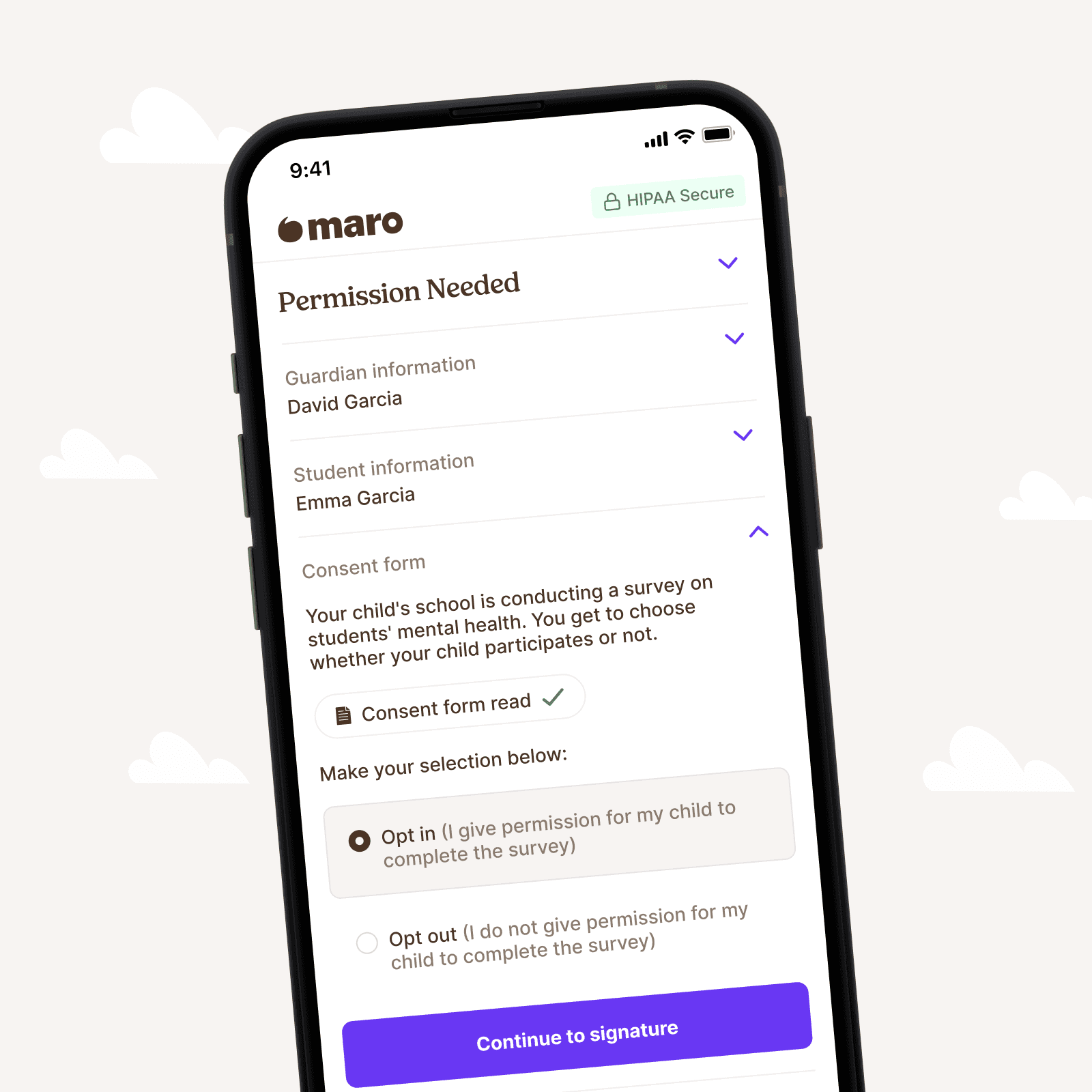
Maro provides schools with a customizable family communication toolkit. We track parent consents (for opt out and opt in use cases), bilingual parent communication, clear FAQs and easy-to-understand consent forms.
ECHO Alternative School
Regional Office of Education 21 | Illinois
Data, privacy & compliance
Guidance continues to emerge, but here are some best practices:
Parents have the right to request access to their students’ screening results.
District screening data should be accessible only to staff directly involved in student support: counselors, social workers, and administrators with a direct role in student follow up / intervention. Results should not be visible to general classroom teachers without a specific, documented need.
Districts should maintain:
A record of which students were screened, when, and with what tool
Results and risk level for each student screened
Follow-up actions taken for students who screened positive, including dates and staff involved
Opt-out records for students whose families declined participation
A Note on Digital Platforms
If you’re using a digital platform to administer screening and manage results, verify that the platform is FERPA-compliant and that your data processing agreement (DPA) is in place before you go live.
Maro has signed the Illinois Standard Student Data Privacy Agreement (IL-NDPA). Our platform offers full data privacy and regulatory compliance in Illinois.
Universal mental health screening checklist
Use this checklist to structure your district's planning.
Without Maro:
☐ Review SB1560 requirements and ISBE guidance
☐ Identify your district mental health screening coordinator
☐ Evaluate and select screening tools
☐ Build triage workflow: who acts on results and in what timeframe
☐ Establish data access permissions
☐ Execute data processing agreement (DPA) with any technology vendors
☐ Develop family communication templates
☐ Assess community resource landscape: where are students being referred?
☐ Deliver staff training for counselors and administrators
☐ Conduct pilot screening with one building or grade band
☐ Debrief with counselors after pilot: what worked, what didn’t
☐ Refine triage workflow based on pilot learnings
☐ Document consent process and track responses
☐ Finalize district-wide rollout plan & conduct district-wide screening
☐ Complete all required follow up documentation
☐ Review aggregate data at district level to identify building-level patterns
With Maro:
Simply schedule an onboarding with our Illinois team. We’ll handle everything from there!


Where to go from here
Start planning for screening sooner rather than later to give your staff plenty of time to feel comfortable with the technology, tools and game plan. If you’re building your school or district plan and want to see how other Illinois districts are structuring their screening programs, we’re happy to provide examples and best practices. Maro works specifically with K–12 districts on evidence-informed screening programs. We’ve helped districts across Illinois implement workflows that protect counselor capacity, keep families informed, and ensure students who need support don’t fall through the cracks. Let’s get students the help they need.
Learn more and connect with our team: meetmaro.com/illinois
Our mission is to eliminate the average 11 year gap between first symptom & treatment in youth mental health.
Let's get your school ready for SB1560
Two minutes is all it takes. Fill out a short questionnaire about your school and we'll let you know instantly if your school is eligible for free screening and implementation.